Sunday, May 25, 2014

BOWLING FOR AURORA

I have nothing new to offer in response to the 23 May Santa Barbara killing spree. Instead, I’ll post a short essay from my book It Happened at the Movies here.

No guns, no killing.
- Batman (Christopher Nolan's The dark Knight Rises)

You can't get around the fact that people who carry guns tend to get shot more than people who don't.
- Abernathy (Quentin Tarantino’s Death Proof)

Movies don’t create psychos. Movies make psychos more creative.
- Billy (Wes Craven’s Scream)

Many household items can be used a weapons, but firearms serve no other purpose than to inflict harm upon others.
- My pappy

On July 20, 2012, James Holmes Some Gun-toting Asshole who shouldn’t be made a celebrity, 24, entered the Century Aurora Theater in Aurora, Colorado, and opened fire on those attending a midnight screening of The Dark Knight Rises. Some Gun-toting Asshole killed 12 people and injured 58.

In the wake of this tragedy, two tired debates have flared up again: “Should we rethink the second amendment?” and “Do cultural texts have a negative effect on their audiences?”
I’ll be brief about the gun issue. Americans pride themselves on having a limited government; they would not take kindly to it if their constitutional right to keep and bear arms were to be restricted. Besides, banning firearms would have the same impact as making heroin illegal: none whatsoever. If a determined American wants to own a pistelero, they will find a way.
Personally, I find the argument that lives could have been saved had moviegoers carried guns both ludicrous and maddening. In such naïve scenarios, our hypothetical heroes are in a constant state of heightened alertness and clarity, standing by to respond in a swift and infallible manner. Nevertheless, tempting as it may be to point an accusing finger at the second amendment, it would be unwise to forget that the USA is by no means the only country that allows private citizens to own firearms. Just look at Switzerland’s unique and successful gun politics. What’s going on in the United States appears to be a sociocultural problem. A more interesting debate question would thus be: Why do these kinds of shooting rampages usually occur on American soil?
Some saw fit to put the blame on the The Dark Knight franchise. Some Gun-toting Asshole's attire vaguely resembled that of main villain Bane; his hair was dyed a ghastly orange; he allegedly told his arresting officers that he was The Joker.
I don't believe in “art imitating life.” It’s always the other way around. Even an extravagant film like Star Wars, which features far away galaxies and alien species, takes its cues from life as we know it by dealing with all too familiar emotions such as love, fear, jealousy, hatred, and hope.
I also don't believe in a hypothetical situation where a Joe Doakes comes home from work, kisses the missus, plays with the 2.5 kids, enjoys supper, turns on the boob tube for some R&R, and then morphs into a trigger-happy mass-murderer when he happens upon The Expendables while channel-surfing.
I do believe, however, that if Christopher Nolan’s Batman films and the second amendment didn’t exist, Some Gun-toting Asshole still would have come to the decision to harm people.
And he would have found a way to do it.

A Smith & Wesson M&P15. One of the guns used in the Aurora shootings.

Saturday, May 24, 2014

NEW BOOK. SOON.


Photography: Holly Ruppert. Model: Serena Taylor. Click to enlarge.

Saturday, March 1, 2014

LARS VON TRIER ANTICHRIST


I’m not in clover! It’s cold as a witch’s teat in my neck of the woods and Aunty Flow’s monthly visitation lasted longer than expected. Long story short, I didn’t get to drop by the Cineplex as often as last month and won’t be able to present you lot with a February round-up. What’s a devochka to do? She telegraphs a certain feller and begs him for permission to reprint one of her contributions to his 2010 anthology, Vigil. (Still available as paperback and on iTunes.)
So, instead of giving you my two cents on Lars von Trier’s latest sh(l)ockfest, Nymphomaniac, here's my ancient review of the man's 2009 horror flick, Antichrist:

In an awkward, vain attempt to make me more appreciative of the finer things, Older Sister sent me a small parcel containing three DVD‘s of films by Danish enfant terrible Lars von Trier.
The films in question were Breaking the Waves, Dancer in the Dark, and Dogville. The first flick revolves around a childlike woman who, egged on by her God, beds as many men as possible to save her injured husband, and dies trying. Nice. The second one tells the story of a woman who suffers from Macular Degeneration, is robbed blind (no pun intended) by her neighbor, and eventually receives the death penalty for a crime she didn‘t commit. Oh happy days. The third and last film centers on a woman who unselfishly helps the people of a hamlet and is chained to a cylinder block and raped repeatedly as a thank you.
O, High Art, where hast thou been all my life?

Cute Boy called me this weekend and our telephone conversation went something like this:
Cute Boy: You wanna catch a movie with me?
Me: Yay!
Cute Boy: I got tickets for a horror film titled Antichrist.
Me: Hurray!
Cute Boy: Its director is a Viking by the name of Lars von Trier.
Me:


While an unnamed couple (Willem Dafoe and the lovely Charlotte Gainsbourg) is enjoying hardcore sex, tragedy strikes when toddler Nick crawls out of his crib, heads toward the open window, and plunges to his death at the exact same moment his parents climax.
Holy la petite mort, Batman!
Gainsbourg is inconsolable and committed to Ye Olde Institute for the Ridiculously Nervous. Dissatisfied with the treatment his wife receives, experienced psychoanalyst Dafoe takes Gainsbourg home and subjects her to his own abrasive twelve-step program. The unstable Gainsbourg is partial to humping the pain away; Von Trier‘s camera makes sure we get a good look at the couple‘s genitals. (For the first of what would be many times that evening, Cute Boy turned to me and whispered, “Sorry, I didn‘t know it‘d be like this.”)
Dafoe asks Gainsbourg what scares her the most, and she says it‘s Eden Forest, where she and baby Nick spent the previous summer in a cabin to finish her thesis on gendercide. Dafoe suggests they go up there so she can face and overcome her irrational fears.
Gainsbourg barks that he never showed much interest in what makes her tick until she became his patient - his project - but concurs all the same.
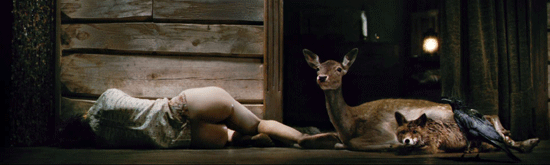
Once there, they do the nasty some more (“Sorry, I didn‘t know it‘d be like this.”) and Dafoe encounters three animals we later learn represent Pain, Grief, and Despair: a reanimated fox who declares, “Chaos reigns”; a miscarrying deer; and a crow whose chick has fallen out of its nest.
As the insatiable Gainbourg mounts her hubby that night, she asks of him to slap her. When he refuses, she runs out into the woods and ferociously tickles her pink speed dial under a tree. (“Sorry, I didn‘t know it‘d be like this.”)
Things take a turn for the worse when Dafoe confronts Gainsbourg with Nick‘s autopsy report: as a result of Gainbourg constantly putting his shoes on the wrong feet, the toddler‘s cuneiform bones were deformed. Gainsbourg responds evasively by telling him her fear of Eden started when she was perturbed by cries of anguish coming from the woods. He tells her she must have imagined it; she shoots back that women and nature are inherently evil. Dafoe says she‘s a few cans short of a six-pack. She confesses she actually saw Baby Nick was in trouble but didn‘t act on it, instead preferring to orgasm.


Realizing she used sex to ease a pain sex was actually the very cause of, Gainsbourg smashes Dafoe‘s penis with a two-by-four and masturbates her unconscious better half until he ejaculates blood. (“Holy shit! I‘m sorry, I really didn‘t know it‘d be like this!”)
Gainsbourg remains sans panties as she unceremoniously drills a hole in Dafoe‘s leg and bolts a grindstone to it. She then takes a pair of rusty shears to her privates and, in an astonishingly realistic close up, performs a little home auto-clitoridectomy.
Dafoe comes to and, unaware of Gainsbourg‘s self-inflicted wounds, retaliates by strangling her to death and burning her body. As he gets ready to leave, he comes across hundreds of women with blurred faces ascending the hill. Fin.
“What the fuck was that all about?” Cute Boy said aloud to no one in particular when end credits started rolling. He rushed off to the lavatory and I briefly chatted with a couple of other girls in the foyer. One of them called the film horribly misogynistic while the other raised her glass and said, “Here‘s to girl power. Charlotte was the bomb!”

Cute boy had not needed to offer genuinely embarrassed apologies every time a “shocking” image appeared on screen; Antichrist failed to evoke a sense of dread or horror because its provocations seemed calculated and oddly aloof. Von Trier‘s film is expertly made – whenever I gasped, not fear but superficial admiration was the catalyst. I‘m not saying this to come across as your regular Sarah Connor. Truth be told, I‘m actually a Nervous Nelly, scared witless by Paranormal Activity, that other late fall frightfest.
I‘m more than sympathetic to those who‘ve taken a beating from Antichrist, but I don‘t think its Scandinavian auteur is a Haneke or Tarkovsky, who use the language of cinema to express their stances on sociopolitical and theological issues. Von Trier reminds me more of Billy Hastings, a fellow kindergartener who enjoyed getting a rise out of the other kids by showing them his collection of squashed insects. (According to his Facebook page, Billy‘s in law school now. Figures.)
I like to think of Von Trier as a naughty filmmaker who relishes catcalls. Hitchcock once said he enjoyed playing the audience like a piano; Von Trier plays his audience like an electric guitar and smashes the instrument when he completes his set.
Those familiar with the director‘s oeuvre know that a gleeful Von Trier showed up at the end of every episode of his mini-series Riget to offer enigmatic clues. He also took center stage in the theme song‘s official music video. A year later, Von Trier performed a tongue-in-cheek rendition of Peter Skellern‘s song You‘re a Lady to promote his film Idioterne.


Having a pretty good idea of where Von Trier‘s coming from, I was giggling mere seconds into Antichrist. The first onscreen title doesn‘t read "A film by Lars Von Trier" or "Lars Von Trier‘s Antichrist," but "Lars Von Trier. AntiChrist."
O, Lars…you little rascal, you!
The monochrome prologue, admired by many for its visual power and haunting score (Händel‘s Lascia Ch‘io Pianga), also tickled my funny bone because of its similarity to an episode of The Simpsons. Remember when the town of Springfield played host to a film festival? One of the submitted entries was Barney Gumble‘s "Pukahontas", a black & white autobiographical short subject that detailed his life as a substance abuser through time-lapse photography, a score by Philip Glass and Puccini, quotes from Othello, and such images as a rose withering and dying while silk curtains billow in the wind.


For my money (technically Cute Boy‘s money), Antichrist is Von Trier‘s 100 minute remake of "Pukahontas" (with a dash of Roberta Allsworth's "Mirror, Father, Mirror" for good measure) and should have ended with a legend reading "Calvin Klein For Men."


If you so happen to be one of those haughty film students who are showered with praise for spotting the pain/grief/despair figurines on little Nick‘s desk, noticing the crow/fox/deer puzzle Dafoe and Gainsbourg make whoopee on in the opening scene, and mentioning Nietzsche and Freud when discussing Antichrist, please keep the following in mind:


Thursday, January 30, 2014

JANUARY ROUNDUP

Here be the January roundup of films I caught this month. Spoiler-free capsule reviews, alphabetized (definite articles are ignored) and slapped with a star rating. No stars for wastes of celluloid or digital storage space, four stars for the absolute cream of the crop.

AHI VA EL DIABLO ««
(Adrián García Bogliano, 2013)
Sexually charged horror is Rosemary’s Baby by way of Lucía y el Sexo. Tween siblings go missing for one night but return home behaving like somnambulistic body snatchers. The intransigent Bogliano clutters his film with so many genre tropes that most of them are dealt with unsatisfactorily. Released abroad as Here comes the Devil.

BELL WITCH HAUNTING, THE «
(Glenn Miller, 2013)
Production company Asylum, known for its shoestring imitations of blockbusters, tries its gnarly hand at the found footage genre and delivers, quelle surprise, a laughable piece of guano. If you take a shot of Jim Beam every time you spot a grammatical error in the various title cards, you’ll be on life support long before end credits roll.

Never comfort your terrified daughter without turning on 
your trusty camera first.

CARRIE ««
(Kimberly Peirce, 2013)
Zealous woman disapproves of her bullied daughter’s telekinetic powers. Film at eleven. Leads Chloë Grace Moretz and Julianne Moore cannot be blamed, but this third adaptation of Stephen King’s debut novel is witless and bland. A more fitting title would have been “Carrie 90210.”

CITADEL ««½
(Claran Foy, 2012)
After his heavily pregnant wife is attacked by the hooded freaks from David Cronenberg’s The Brood, Scotsman Tommy develops a severe case of agoraphobia. Ambitious horror deals with both social issues and one man’s PTSD, but the plot contains more holes than a chunk of Gouda. The profane vicar and his idiot lectures got on my nerves.

ENDER’S GAME ««1½
(Gavin Hood, 2013)
A young boy is deemed “the one to save the universe.” Sounds familiar? It’s quite obvious that the studio dusted off this 1985 book by bigot author Orson Scott Card hoping to jumpstart a new book-based franchise in the vein of Twilight, Harry Potter, and The Hunger Games. Problem is that Ender’s Game is a “cold” story, taking place on a military basis populated by stand-offish characters. Too long and convoluted for the intended audience, it’s no wonder this one hardly broken even at the box office. Probably would have worked wonders as a mini-series. Asa Butterfield is fine as Ender; Harrison Ford looks old and tired as Colonel Graff.

GRUDGE MATCH  ««
(Peter Segal, 2013)
Farce about two rival pugilists coming out of retirement for their long-awaited third fight. These aging sportsmen are portrayed by actors who once upon a time starred as famous boxers: De Niro played Jake LaMotta in Raging Bull; Sylvester Stallone reprised his role as Rocky Balboa no fewer than five times. As was the case with most recent De Niro comedies, Grudge Match relies on a tried, tired sitcom formula. Additional points deduction for the horrible CGI in the opening sequence. Kim Basinger looks as lovely as ever.

HER «««½
(Spike Jonze, 2013)
In the near future, lovelorn Theodore is a copywriter who excels at penning commissioned love letters. One day he downloads a personal organizer app voiced by the hoarse Scarlett Johansson … and falls in love with “it.” This easily could have been the sort of ludicrous comedy Adam Sandler has a monopoly on, but writer/director Jonze presents us with an unpredictable, poignant, thought-provoking tale of love (in the digital age). In need of light pruning.

Theodore and his, um, pocket-sized lady friend.

HOBBIT: THE DESOLATION OF SMAUG, THE ««½
(Peter Jackson, 2013)
The further adventures of a reluctant Hobbit warrior. I maintain that turning Tolkien’s slender children’s book into another 9 hour saga is needlessly excessive, but at the very least this intermittently entertaining second chapter is better than the humdrum An Unexpected Journey. Dragon Smaug is a triumph of digital wizardry.

HUNGER GAMES: CATCHING FIRE , THE «««
(Francis Lawrence, 2013)
After surviving a post-apocalyptic survival of the fittest, new iliads await rebellious teen Katniss. The second book in Suzanne Collins’s trilogy disappointed me, so I initially passed on the adaptation when it hit theatres. Verdict: this is one of those rare instances where I enjoyed the film better than the source novel. Lawrence, taking over directing duties from Gary Ross, brought a tripod to the set. Bliss.

INSIDE LLEWYN DAVIS «««
(Joel Coen, Ethan Coen, 2013)
An account of fiddler Llewyn Desmond’s week on skid row. It’s a cinch that even though I enjoy Coen Brothers movies, I never much care for their characters. (The Coens always seem to invite us to laugh at their personages, never with them.) Bearing in mind that I have little patience with bluegrass music, I expected sitting through the bros’ latest would prove trying. I’m happy to say the film turned out to be a treat. I tapped my footsies to the tunes and emphasized with Davis’s plight.

MANIAC ««½
(Franck Khalfoun, 2013)
Remake of 1980 video nasty that sent the late Gene Siskel running is told entirely from killer Elijah Wood’s perspective. The idea came, I suppose, from Halloween’s famous opening shot, which made the audience observe the world through the peepers of a madman. Sustaining this trick for a film’s duration is perhaps too much of a good thing, especially when shots keep changing from wide to medium and back again without Wood moving so much as a single muscle. Still, it’s an interesting genre piece with good acting and a delicious score.

PARANORMAL ACTIVITY: THE MARKED ONES ««
(Christopher Waldon, 2013)
High school graduates wielding a video camera discover something weird is going on in their tenement. Could it be something … paranormal? Why Paramount presents this installment as a spin-off in lieu of “part 5" is a question worth considering. Either way, The Marked Ones is better than it has any reason to be, rocking some funny bits and ending on a decidedly crackpot note. Enough is enough, though.

SLEEPWALKERS ««
(Mick Garris, 1992)
Oldie but baddie. My appreciation of Stephen King the novelist is only exceeded by my dislike of Stephen King the screenwriter. Everything that makes the Master of Macabre’s bibliography compelling is absent from his scripts. Sleepwalkers, written directly for the screen, revolves around mythical humanoids whose sustenance is the “life essence” of virgins. King repeatedly nixes every potential scare by including such elements as shape shifting automobiles, juvenile one-liners, and pointless cameos by novelists and filmmakers.

TWELVE YEARS A SLAVE «««½
(Steve McQueen, 2013)
True story of free black Solomon Northup, kidnapped by conmen and sold into slavery. We know upfront that a happy ending is in the cards for Northup, so the film works best when it focuses on the general monstrosities of slave trade. Weighed down by distracting celebrity cameos.

TWIXT «½
(Francis Ford Coppola, 2011)
Oy vey. From the once great Coppola (The Godfather, The Conversation, Apocalypse Now) comes this critically drubbed horror tale of a hack writer (Val Kilmer, looking like he spent too much time at the old country buffet) entangled in a supernatural murder mystery. Coppola is still enough of a talent to keep things visually arresting, but this project is tainted by a paucity of vigor. Shot in 2011, released in 2013.

Stocky Val Kilmer is on sale. A steal at 19,99!

VIE D’ADELE – CHAPITRES 1 ET 2, LA «««
(Abdellatif Kechiche, 2013)
After a fling with classmate Thomas, unassuming teen Adèle falls for gay art student Emma. Thusly begins a romantic epic that chronicles their relationship from “meet cute” to “pink goggles come off” to “neck or nothing.” Just Palm d’Or winner is a powerful affair deserving of its many accolades, but I found fault with the film’s long sex scenes, which tread a fine line between frankly intimate and gratuitous. I’m no prude; I even enjoy exploitation cheapies that feature scantily clad women beating up vile menfolk. (I’m fully aware that these aren’t so much female empowering showcases as fetishistic fantasies of male directors.) But La Vie d’Adèle is a serious drama, which makes it lamentable that Kechiche foregoes his cínema vérité approach whenever the leads disrobe, capturing the nubile women’s naked bodies from every possible angle as they bathe, masturbate, perform cunnilingus, and suckle each other's nipples. (The actresses have gone public with their dislike of Kechiche’s intimidating on-set behavior.) There are additional flaws: much is made of Adèle’s friends and parents’ conservative stance on relationships, so why are these parties unceremoniously dropped from the storyline once Adèle moves in with Emma? All things considered, La Vie d’Adèle is a very good film with more than a few false notes. International title: Blue is the Warmest Color. Based upon Julie Maroh’s graphic novel Dark Angel.

WOLF OF WALL STREET, THE «««½
(Martin Scorsese, 2013)
Scorsese’s best and most energetic outing since Goodfellas (1990). It’s no coincidence that Wolf, too, deals with the rise and fall of an unlikable crook addicted to money, sex, and a variety of illegal substances. Whereas the dark Goodfellas crackled with ultraviolence, Wolf successfully tries to tickle your funny bone with its antihero’s clandestine hijinks. Adapted from the memoirs by Jordon Belfort.

YOU’RE NEXT  «««
(Adam Weinbaum, 2013)
Tense family reunion is cut short when masked killers come barging in. Darkly comic slasher pleased mainstream critics but antagonized horror puritans. With Umberto Eco’s definition of postmodernism in mind, I’m not above taking my 21st century horror films with a scoop of irony, thanks heaps. The filmmakers also deserve a pat on the back for steering the narrative into several unconventional directions.