I’m not in clover! It’s cold as a witch’s teat in my neck of the woods and Aunty Flow’s monthly visitation lasted longer than expected. Long story short, I didn’t get to drop by the Cineplex as often as last month and won’t be able to present you lot with a February round-up. What’s a devochka to do? She telegraphs a certain feller and begs him for permission to reprint one of her contributions to his 2010 anthology,
Vigil. (Still available as
paperback and on
iTunes.)
So, instead of giving you my two cents on Lars von Trier’s latest sh(l)ockfest,
Nymphomaniac, here's my ancient review of the man's 2009 horror flick,
Antichrist:
In an awkward, vain attempt to make me more appreciative of the finer things, Older Sister sent me a small parcel containing three DVD‘s of films by Danish enfant terrible Lars von Trier.
The films in question were
Breaking the Waves, Dancer in the Dark, and
Dogville. The first flick revolves around a childlike woman who, egged on by her God, beds as many men as possible to save her injured husband, and dies trying. Nice. The second one tells the story of a woman who suffers from Macular Degeneration, is robbed blind (no pun intended) by her neighbor, and eventually receives the death penalty for a crime she didn‘t commit. Oh happy days. The third and last film centers on a woman who unselfishly helps the people of a hamlet and is chained to a cylinder block and raped repeatedly as a thank you.
O, High Art, where hast thou been all my life?
Cute Boy called me this weekend and our telephone conversation went something like this:
Cute Boy: You wanna catch a movie with me?
Me: Yay!
Cute Boy: I got tickets for a horror film titled
Antichrist.
Me: Hurray!
Cute Boy: Its director is a Viking by the name of Lars von Trier.
Me:
While an unnamed couple (Willem Dafoe and the lovely Charlotte Gainsbourg) is enjoying hardcore sex, tragedy strikes when toddler Nick crawls out of his crib, heads toward the open window, and plunges to his death at the exact same moment his parents climax.
Holy la petite mort, Batman!
Gainsbourg is inconsolable and committed to Ye Olde Institute for the Ridiculously Nervous. Dissatisfied with the treatment his wife receives, experienced psychoanalyst Dafoe takes Gainsbourg home and subjects her to his own abrasive twelve-step program.
The unstable Gainsbourg is partial to humping the pain away; Von Trier‘s camera makes sure we get a good look at the couple‘s genitals. (For the first of what would be many times that evening, Cute Boy turned to me and whispered, “
Sorry, I didn‘t know it‘d be like this.”)
Dafoe asks Gainsbourg what scares her the most, and she says it‘s Eden Forest, where she and baby Nick spent the previous summer in a cabin to finish her thesis on gendercide. Dafoe suggests they go up there so she can face and overcome her irrational fears. Gainsbourg barks that he never showed much interest in what makes her tick until she became his patient - his
project - but concurs all the same.
Once there, they do the nasty some more (“
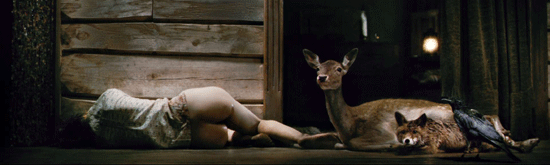
Sorry, I didn‘t know it‘d be like this.”) and Dafoe encounters three animals we later learn represent Pain, Grief, and Despair: a reanimated fox who declares, “Chaos reigns”; a miscarrying deer; and a crow whose chick has fallen out of its nest.
As the insatiable Gainbourg mounts her hubby that night, she asks of him to slap her. When he refuses, she runs out into the woods and ferociously tickles her pink speed dial under a tree. (“
Sorry, I didn‘t know it‘d be like this.”)
Things take a turn for the worse when Dafoe confronts Gainsbourg with Nick‘s autopsy report: as a result of Gainbourg constantly putting his shoes on the wrong feet, the toddler‘s cuneiform bones were deformed. Gainsbourg responds evasively by telling him her fear of Eden started when she was perturbed by cries of anguish coming from the woods. He tells her she must have imagined it; she shoots back that women and nature are inherently evil. Dafoe says she‘s a few cans short of a six-pack. She confesses she actually saw Baby Nick was in trouble but didn‘t act on it, instead preferring to orgasm.
Realizing she used sex to ease a pain sex was actually the very cause of, Gainsbourg smashes Dafoe‘s penis with a two-by-four and masturbates her unconscious better half until he ejaculates blood. (“
Holy shit! I‘m sorry, I really
didn‘t know it‘d be like this!”)
Gainsbourg remains sans panties as she unceremoniously drills a hole in Dafoe‘s leg and bolts a grindstone to it. She then takes a pair of rusty shears to her privates and, in an astonishingly realistic close up, performs a little home auto-clitoridectomy.
Dafoe comes to and, unaware of Gainsbourg‘s self-inflicted wounds, retaliates by strangling her to death and burning her body. As he gets ready to leave, he comes across hundreds of women with blurred faces ascending the hill.
Fin.
“
What the fuck was that all about?” Cute Boy said aloud to no one in particular when end credits started rolling. He rushed off to the lavatory and I briefly chatted with a couple of other girls in the foyer. One of them called the film horribly misogynistic while the other raised her glass and said, “
Here‘s to girl power. Charlotte was the bomb!”
Cute boy had not needed to offer genuinely embarrassed apologies every time a “shocking” image appeared on screen;
Antichrist failed to evoke a sense of dread or horror because its provocations seemed calculated and oddly aloof. Von Trier‘s film is expertly made – whenever I gasped, not fear but superficial admiration was the catalyst. I‘m not saying this to come across as your regular Sarah Connor. Truth be told, I‘m actually a Nervous Nelly, scared witless by
Paranormal Activity, that other late fall frightfest.
I‘m more than sympathetic to those who‘ve taken a beating from
Antichrist, but I don‘t think its Scandinavian auteur is a Haneke or Tarkovsky, who use the language of cinema to express their stances on sociopolitical and theological issues. Von Trier reminds me more of Billy Hastings, a fellow kindergartener who enjoyed getting a rise out of the other kids by showing them his collection of squashed insects. (According to his Facebook page, Billy‘s in law school now. Figures.)
I like to think of Von Trier as a naughty filmmaker who relishes catcalls. Hitchcock once said he enjoyed playing the audience like a piano; Von Trier plays his audience like an electric guitar and smashes the instrument when he completes his set.
Those familiar with the director‘s oeuvre know that a gleeful Von Trier showed up at the end of every episode of his mini-series
Riget to offer enigmatic clues. He also took center stage in the theme song‘s official music video. A year later, Von Trier performed a tongue-in-cheek rendition of Peter Skellern‘s song
You‘re a Lady to promote his film
Idioterne.
Having a pretty good idea of where Von Trier‘s coming from, I was giggling mere seconds into
Antichrist. The first onscreen title doesn‘t read "A film by Lars Von Trier" or "Lars Von Trier‘s
Antichrist," but "Lars Von Trier.
AntiChrist."
O, Lars…you little rascal, you!
The monochrome prologue, admired by many for its visual power and haunting score (Händel‘s
Lascia Ch‘io Pianga), also tickled my funny bone because of its similarity to an episode of
The Simpsons. Remember when the town of Springfield played host to a film festival? One of the submitted entries was Barney Gumble‘s "Pukahontas", a black & white autobiographical short subject that detailed his life as a substance abuser through time-lapse photography, a score by Philip Glass and Puccini, quotes from
Othello, and such images as a rose withering and dying while silk curtains billow in the wind.
For my money (technically Cute Boy‘s money),
Antichrist is Von Trier‘s 100 minute remake of "Pukahontas" (with a dash of Roberta Allsworth's "Mirror, Father, Mirror" for good measure) and should have ended with a legend reading "Calvin Klein For Men."
If you so happen to be one of those haughty film students who are showered with praise for spotting the pain/grief/despair figurines on little Nick‘s desk, noticing the crow/fox/deer puzzle Dafoe and Gainsbourg make whoopee on in the opening scene, and mentioning Nietzsche and Freud when discussing
Antichrist, please keep the following in mind:


.jpg)